

Australia’s R&D: A national asset in crisis
By Sandy Plunkett

It is a sad indictment of Australian business complacency that in 2025 – when the world economy and geopolitics are being transformed by AI and data, biomedical and materials sciences, advanced manufacturing and defence technologies – we are still having to explain that innovation is the driver of every modern economy and the key to competitiveness, productivity and security.
But that’s how Tesla chair Robyn Denholm began her Op Ed in the nation’s business daily last week.
Denholm is chairing the federal government’s first Strategic Examination of Australia’s R&D system in 20 years. She kicked off the review with a declaration that our plummeting innovation and R&D commercialisation output is a national emergency.
It is a national humiliation that a supposedly “clever country” reeling from crises in cost of living and energy and continuing its downward slide in global rankings of productivity and economic complexity, has repeatedly failed to heed the “innovate or die” mantra.
The R&D Review’s first discussion paper released last week is touted by federal minister for Industry and Science, Ed Husic. as a “no holds barred reconnaissance of our R&D landscape and areas for improvement.”
The paper presents a clear overview of the cultural and structural problems that make Australia “bottom of the class” in translating research into products, services and new businesses at any meaningful scale.
And like so many thoughtful papers dissecting the nation’s dismal R&D and commercialisation output over a generation, it lays out what we have long known.
It is all still very painful to read.
Australian investment in R&D has dropped to 1.66 per cent of GDP, less than two-thirds the OECD average and way short of the mooted 3 per cent goal the Labor government said it was aiming for when it first came to office.
The main cause of this decline is falling business and government R&D expenditure.
Business R&D intensity (BERD as a proportion of GDP) is a dismal 0.88 per cent, declining from its peak of 1.37 per cent. Government investment (GERD) has declined from 0.27 per cent of GDP to 0.16 per cent over the same period.
Australia’s changing economic structure – the mining sector’s shift from exploration and development to production, and a decadal shift since the 1960s from manufacturing to services – has added to recent declines in BERD and GERD.
And while manufacturing has historically been the dominant contributor to higher R&D intensity in peer countries, Australian manufacturing has fallen to 5.85 per cent of GDP (the lowest in the OECD). It also has both lower R&D intensity and contribution to Gross Value Added (GVA) than our regional and global peers.
Only R&D expenditure in the professional, scientific and technical services sector has been increasing, now at 34 per cent of BERD in 2021–22.
Figure 8: RGD intensity of OECD countries over time

Source: OECD Main Science and Technology Indicators
Figure G: Australian expenditure on RGD by sector as a percentage of GDP

Source: ABS, Research and Experimental Development, Businesses, Higher Education Organisations, and Government and Private Non-Profit Organisations
Nations with high R&D (and commercialisation) intensity invest significantly more than Australia in experimental development and calculated risk activity.
As they are building sovereign capability in critical technologies and new industries, fast-follower countries like Israel or South Korea, develop a canny integration of both foreign technologies and novel, export-earning ones.
But for decades, Australia has relied overwhelmingly on technology adoption as the primary mechanism for innovation and despite 46 per cent of Australian firms claiming to be innovation-active, only 1–2 per cent of Australian businesses engage in new-to-the-world innovation.
As a result, the Australian economy is one of the least differentiated in the world.
It is still reliant on raw resources, education “exports” and tourism; our startup sector is underfunded and relatively unsophisticated; and our technology-driven manufacturers are undercapitalised and constrained in pursuing vital export markets, while domestic demand is also weak.
The billions of dollars we do spend on R&D are siloed and disconnected from business, especially large businesses, and national needs. The myriad programs designed to forge closer ties between research and academia and business have barely moved the dial.
It is indeed a national emergency. But while the numbers get worse and the economy slides further into regional and global irrelevance, the problems have been the same for decades.
So, what will make the outcome of this review any different?
“Simply calling for R&D spending to reach 3% of GDP isn't enough, says Australian Industry Group (Ai Group) Chief Executive Innes Willox.
“This review must transcend previous incremental investigations and deliver genuine, innovative solutions. Everything must be on the table – there can be no sacred cows.”
Most industry insiders agree Willox is right about splashing more cash around.
Yet the Labor Government’s Future Made in Australia agenda is mostly geared to trying to ignite innovation activity among Australia’s large businesses and foreign-owned participants with billions of dollars in subsidies and production tax breaks for critical minerals, aluminium and renewable energy firms.
There has been and will continue to be much debate about the efficacy of those subsidies in achieving the breakthroughs and industrial scale transformation the government thinks could make the nation a green energy superpower.
But if this R&D review is going to turn up new and sustainable solutions, the first sacred cow needing to be killed is the belief that more of Australia’s large businesses will suddenly innovate if only we could get the R&D policy settings right.
Confident, curious, outward-looking societies and businesses with sophisticated management and sufficient capital always see the necessity to innovate. They are continually experimenting, problem solving, building and investing in their present and future competitiveness.
The vast majority of Australia’s businesses don’t do that and likely never will.
As one tech sector insider laments: “Australia is a low self-esteem country. We have not developed the scale of ambition, the skills, nor the speed of execution needed to keep pace with our global competitors.”
Whether low-self esteem or misplaced hubris, the old adage necessity is the mother of invention does not seem to resonate with too many Australian business leaders.
And even if it did, it has proved nearly impossible almost anywhere in the world to turn large non-innovative companies into agile, innovative ones – with and without government subsidies and tax breaks to secure beachheads in new markets and industries.
So, what if the key to positive and sustainable change for the nation means ditching the everything, everywhere all at once approach, and committing to designing solutions that encourage and reward new company formation, risk-taking, competitiveness and growth?
In Australia the relatively small, but high impact cohort of R&D & C-driven growth companies are easily identifiable but largely ignored by policymakers.
Late last year, the Australian Business Growth Fund (ABGF) a $540 million public private fund set up by the former Morrison government in partnership with Australia’s banks and led by former NAB executive, Anthony Healy, released its, Powering the Growth Economy report.
It is the first report dedicated to defining the characteristics, economic impact, growth dynamics and funding needs of the critical 6 per cent of the nation’s 2.5 million SMEs that are the working engine of Australia’s reindustrialisation and economic diversification.
The cohort the ABGF defines as the “Growth Economy” are established businesses with revenues between $2 and $100 million.
They account for a quarter of Australia’s economic output, 42 per cent of all employment and nearly 50 per cent of all R&D spending.
The ABGF also found that these companies have a unique value proposition, are focused on export markets and international supply chains and have sophisticated and ambitious management.
And while they are outstripping other parts of the economy in terms of annual growth – 5.7 per cent vs 4.3 per cent in 2022 – they are also severely limited by a lack of growth and expansion capital. Venture capital is vital for startups, but in Australia it tends to prefer financial and enterprise technology businesses versus R&D intensive deep tech and advanced manufacturing businesses.
But the ABGF analysis, which was based on interviews with more than 3,500 SMEs, as well as ATO and ABS data sets, was not referenced at all in the R&D System Review discussion paper.
That’s a revealing omission.
Similarly, ABGF’s Healy says he has tried to open conversations with the $15 billion National Reconstruction Fund executives for a new equity fund focused on the Growth Economy cohort his fund is already investing in. He has made more than 13 investments in diverse R&D driven companies to date.
But so far there has been little engagement from the NRF, a situation Healy is hoping will change under the new NRF chief executive, David Gall.
If there was ever a time for that conversation, a national economic and R&D emergency would seem to be it.
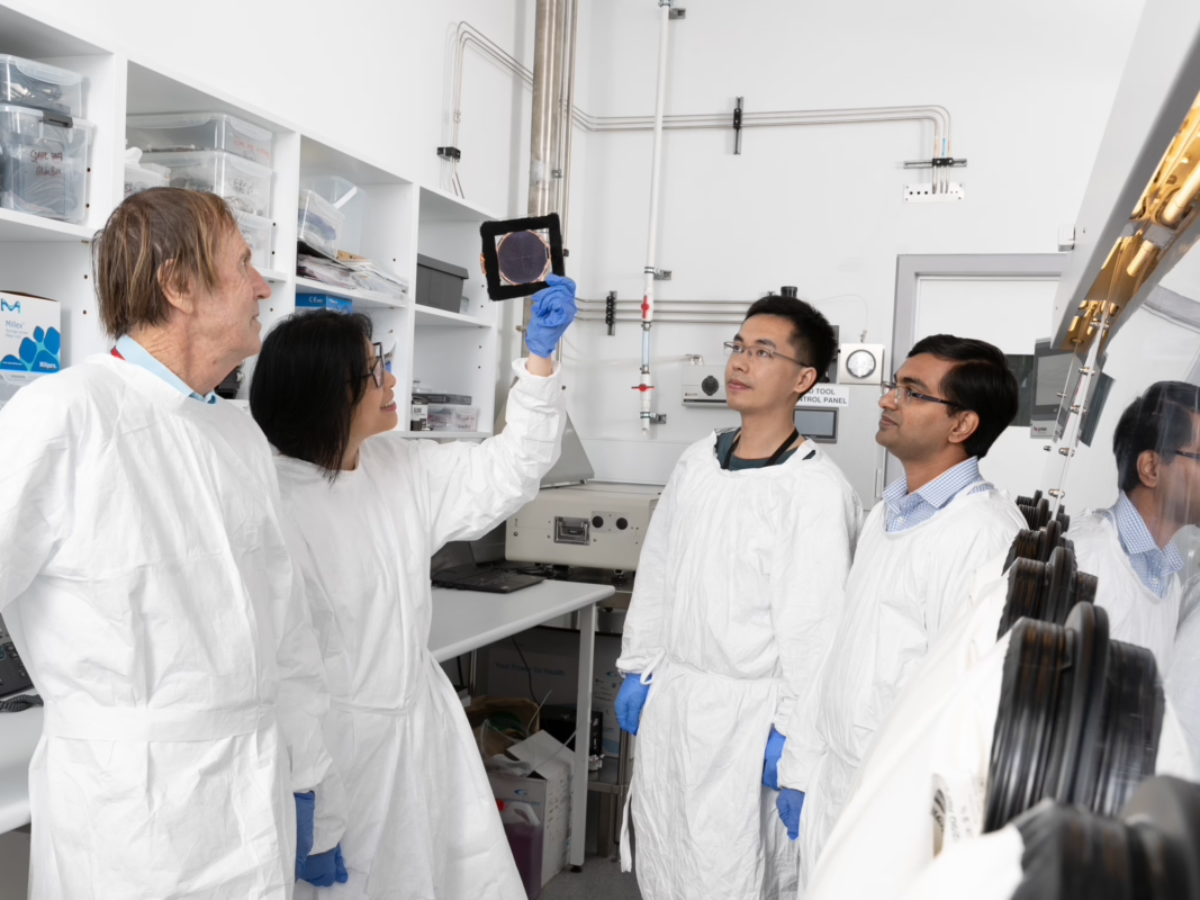
Picture: credit UNSW
Further reading
Towards 3% R&D, Australia’s R&D slide – download our e-book
Government and business R&D stagnating
Government says Australian R&D is strong – it is not
Towards 3% R&D – budget responds to slump in Australian innovation effort
Government response to driving advanced manufacturing in Australia low on commitment

More in this section



@aumanufacturing Sections
Analysis and Commentary Awards Casino reviews Defence Gambling Manufacturing News No deposit Bonus codes Online Casino Podcast Technology Videos