

Australia’s remaining appliance makers under the pump
You have to get a lot right, but there’s an element of right place, right time when it comes to selling water heaters.

According to Simon Terry, who runs one of the last three companies making water heaters in Australia, it’s a “no-interest category”, and you’re in the market once every 15 years.
“My wife often tells me, particularly before we catch up with our friends, that ‘nobody cares about your hot water systems.’ Unfortunately it is very very true,” according to the Dux CEO.
“Our peak time right now is winter – you turn on the hot tap in the morning, you get cold water… You’re only in the market for two days. And I’m yet to see anyone say ‘I’ll wait until I have the money to get hot water.’ They will beg, borrow and steal for hot water.”
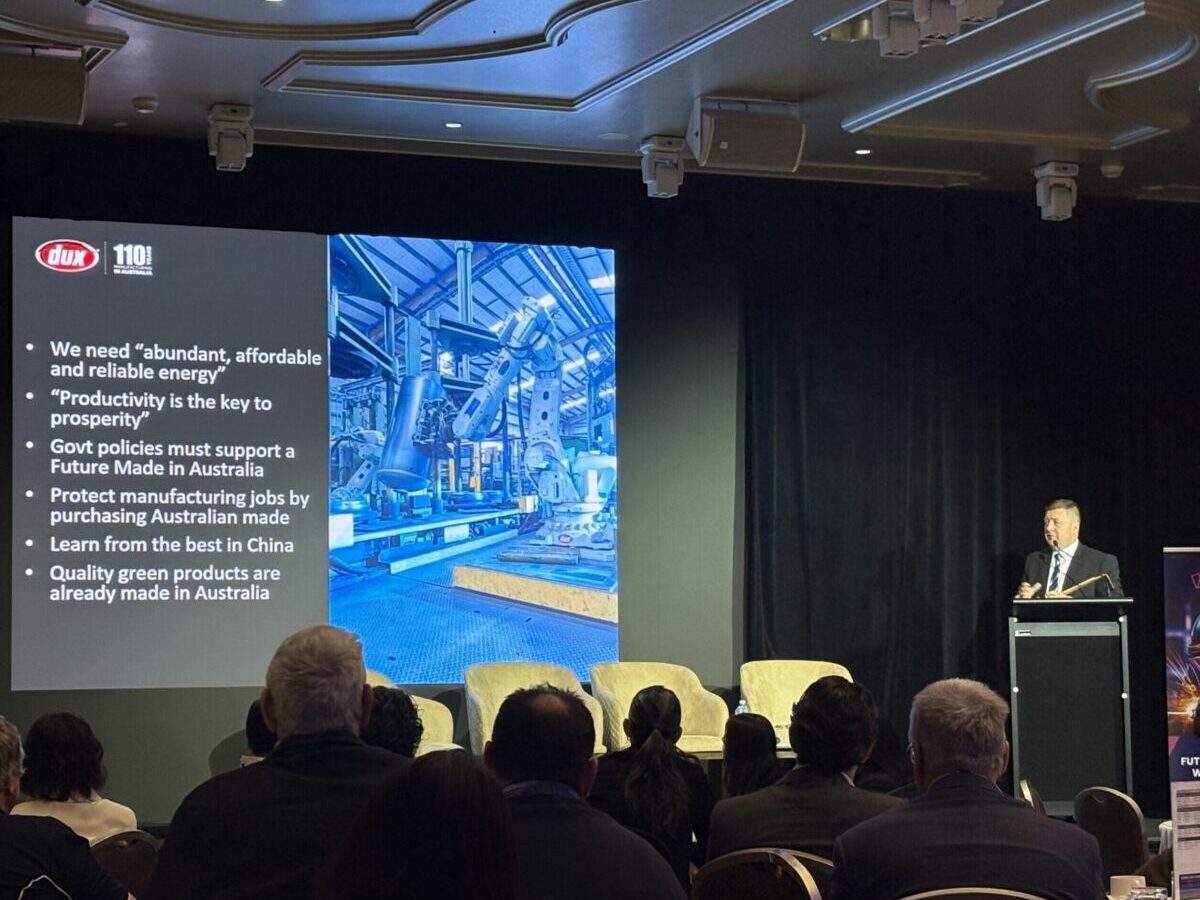
Water heaters are “one of the last appliances still made in Australia”, Terry told the National Manufacturing Summit, hosted by Weld Australia, last week
He also presented evidence that if it's not explicitly the wrong place, there are elements making operating here very difficult.
In Dux’s case, there was even a disappearance of literal elements two decades ago, when supplier Grimwood stopped making these. Elements are now imported from China or Italy.
While the average age of Dux’s 200-ish workforce at Moss Vale has dropped from 46 years to 40 years since 2010 (which Terry credits to its regional location) the price of electricity jumped 65 per cent in one go on January 1.
As with many businesses in the nation, margins are being squeezed by power and gas.
“You couldn’t put more solar panels on our roof if you tried,” explained Terry, who cited IEA figures showing electricity in Australia the highest in the world and twice the price of the US for the period June 14 – July 14.
“In 2023 our gas price was $31 a gigajoule… The gas broker described our price as crippling. We did everything we possibly could to reduce our gas. We had guys coming in early. We built a new furnace.
“We save so much gas, at the end of the year I got a $100,000 bill for not using enough gas. Can you believe that? It is crazy. I’m sure that gas was sold somewhere else. It was actually $120,000, we negotiated it down to $100,000. There was in fairness to them a take or pay clause in our contract. We weren’t looking at that, we were just switching off gas every day.”
Dux has survived, however, and has done so for 110 years, the last ten under the ownership of Japan’s Noritz.
The parent company makes 2 million heaters a year at 11 sites around the world. This means that any investment decision made here competes against China (the Moss Vale site’s entry-level $36/hour wages are up against $6, according to Terry) and Vietnam ($3 an hour.)
As further proof of how difficult operating here is, he cited ASIC insolvency figures, up 33 per cent for all businesses in the year to June.
“Construction is the worst sector. Manufacturing is number six. Insolvencies are up 40 per cent over the last two years,” said Terry.
“That’s terrible.”
So what are the keys to survival?
Terry credits innovation as part of it, with an investment of about 10 per cent of turnovers in R&D and a team of 16 leading this effort.
Quality is also part of the explanation, with the company emphasising longevity and reliability in its presentation, especially against a recent glut of imported heat pumps made “without a quality standard” and subsidies meaning you could effectively “get a heat pump for free for the last two years in NSW and Victoria.”
According to the Dux boss, his company, Rheem and Rinnai are making heat pumps built to “achieve 250,000 cycles” while some certain poorly-made imports are “imploding onsite.”
The lack of a level playing field, according to Terry, meant that: “400,000 heat pumps were imported into Australia [in the last five years.] Only one in 13 was Australian-made. Now that’s a disgrace.”

More in this section



@aumanufacturing Sections
Analysis and Commentary Awards Casino reviews Defence Gambling Manufacturing News No deposit Bonus codes Online Casino Podcast Technology Videos